Tag: lori hamilton

  • In Praise of Great Leaders

    In Praise of Great Leaders

    Study on CEOs and what they are thinking about agility, leadership and new priorities

    My dear friend John Bowen conducted a study of CEOs, what they’ve learned, what they see ahead and what they want most. Turns out, CEOs want what the rest of us want. First, they want to move forward with thoughtfulness and compassion.  Second, they want to be acknowledged for what they have done and tried to do. Hitting the Reset Button

    Have you thanked your leadership today?

    Telling an Inspiring Story: A Superpower of Great Leaders

    I recently taught a class on insights to a team of seasoned experts at an advertising agency. Many of them had advanced degrees and decades of experience. What was the key insight we discussed? The power of STORY. Getting people to tell you their story (respondents, clients, experts, and influencers) and then turning those insights into a story for others to embrace.

    Here’s a visual I found that you might find useful.

    Inspiring Leader – Good Karma Pays Off

    Man with beard and long hair

    Dan Price, Founder & CEO of Gravity Payments
    (
    Image by gravitypayments)   Details   DMCA

    Remember the CEO who was ridiculed for raising the minimum wage?  Six years ago, Gravity Payments CEO Dan Price, 37, discovered one of his employees was working a second job to make ends meet. His response? He gave her, and ultimately everyone in the company a raise to $70,000 per year. He paid for it by dropping his own $1.1 million salary to $70,000. He tweeted “Money buys happiness when you climb out of poverty. But going from well-off to very well-off doesn’t make you happier. Doing what you believe is right, will.

    See how his flexible thinking and kindness have paid off in more ways than one.


    COVID Champions

    While we’re all still walking through COVID, I thought you might enjoy seeing what others are doing out in the world. Isn’t it amazing how a crisis can bring out the best in us?

    Here’s a list of things that companies have done during COVID to make the world of work a better place.

    What inspires you about these stories?

    How can you apply them to your business?

    MetLife LogoMetLife: Global and Local Support for People in Need 

    How MetLife is Helping

    • The MetLife Foundation is providing $25 million in grants to support COVID-19 global relief efforts—directed toward people with urgent needs for food, healthcare, and direct financial assistance
    • Donation of thousands of face masks, bottles of hand sanitizer, and canisters of disinfecting wipes to help those in need
    • Reinforcing claims departments to process increased volume in a timely manner

     MetLife COVID Update CEO FAQ

    As the world navigated the unprecedented impact of the COVID-19 pandemic on every aspect of daily life, MetLife and the MetLife Foundation committed $25 million globally to pandemic relief and recovery by supporting nonprofit partners as they pivoted quickly. Initial grants supported communities and people with urgent needs for food, healthcare, and direct financial support. MetLife Foundation stood by its existing partners on the frontlines of helping low-income people and small businesses build financial health, helping them respond quickly to emerging needs.

    In the U.S., MetLife employees and the MetLife Foundation donated more than $8 million, $2.6 million of which supported U.S. food banks to help address the increased demand for services as a result of COVID-19. In New York City, the Foundation provided nearly $2.3 million in grants to various local organizations.

    Microsoft LogoMicrosoft: Bonuses, Extra Vacation, Changes to Create Hybrid Workforce 

    • Microsoft will spend around $200 million on bonuses it will disburse to many employees in the U.S. and abroad.
    • The software company also gave out extra vacation days earlier this year.

    Source: CNN 7/8/2021

    Microsoft reveals changes it’s made to enable its employees to work both at home and in the office

    • Microsoft has been updating conference rooms, evaluating building-usage data and relying on Teams for sales.
    • The changes appear in a new guide the company published on what the company calls hybrid work.

    Source: CNN 5/24/2021  MCC Mark Cuban Companies logo

    Mark Cuban Companies – Free Reimbursement to Support Local, Small Businesses

    Billionaire Mark Cuban announced on Twitter that he’s reimbursing all his employees who eat lunch at locally owned, independent restaurants amid the coronavirus outbreak.

    “We in! Just sent the email for Mavs and my companies. Anyone who buys from small local, independent (sorry big company-owned chains), will get reimbursed for their lunch and coffee/teas. We will start with this week and go from there,” Cuban, who owns the Dallas Mavericks, wrote.

    Source: NY Post 3/14/2020


    KEEN logo


    Keen Footwear – Free Shoes

    Free Shoes: KEEN Is Giving Away 100,000 Pairs to Those in Need. Send positive vibes and some rugged kicks to an individual or family ‘on the front lines’ or ‘at home fighting through the crisis.’ KEEN will give away some $10 million worth of shoes to help folks weather this surreal and unprecedented time.

    Source: GearJunkie

    JPMorgan Chase & Co Logo


    J.P. Morgan – Investing to Support Health, Safety and Income Challenges

    J.P. Morgan has made a $250 million dollar commitment to support immediate and long-term health challenges, has upgraded technology and safety measures for all their employees and invested in lower-income communities to help address income equality.

    Allstate logoAllstate – Payment Relief and Extended Coverage 

    As the coronavirus pandemic impacts people and businesses across the country, both unemployment and the demand for delivery drivers are on the rise. Many businesses, especially restaurants, are relying on income from delivery services as most people stay home. Allstate is taking action on both fronts to protect customers and employees from life’s uncertainties during these unprecedented times.

    Starting this week and throughout the COVID-19 state of emergency, Allstate will automatically cover customers who use their personal vehicles to deliver food, medicine and other goods for a commercial purpose. Standard personal auto policies typically exclude such coverage.

    Source: Allstate Newsroom

    Twitter logo

    Twitter – Work at Home, Forever  

    Twitter has set a precedent in what the future of work will look like post-lockdown. In response to the success of their remote working practices, all employees have been told by CEO Jack Dorsey that if their role doesn’t require a physical office presence, they can choose to work from home indefinitely.

    Twitter made headlines in May 2020 when CEO Jack Dorsey said employees could work from home “forever” if they wanted. “While opening our offices is our decision, when and if our employees come back, will be theirs.”

    The social networking giant is providing employees options to cover additional daycare expenses incurred due to their childcare/schools closing.

    All employees, including hourly workers, are also receiving reimbursement toward their home office set up expenses.

    Source: Twitter Blog


    Target

    TARGET – Back up Care for Employee’s Families 

    Target took steps to prevent their workers from joining the 5 million women who lost jobs over the past year. The $94 billion retailer introduced an unlimited backup care benefit, providing company-paid in-home or day-care coverage and even tutoring help for virtual school when employees’ families needed it most. “Our team is super thankful for it,” says Amal Mohamud, an executive team leader overseeing human resources for about 200 employees at a Minnesota Target location.

    Source: Fortune 4/12/2021, 3 ways the Best Companies to Work For helped employees endure an unprecedented year


    Cicso Logo 


    Cisco – Taking Care of Employees During Tough Times

    Cisco topped Fortune’s 2021 100 Best Companies to Work For list in part for the way it treated its workers during the coronavirus pandemic, according to the publisher. Cisco has been on the list for 24 consecutive years, Alan Murray, CEO of Fortune, said.

    In response to the pandemic, Cisco delayed layoffs, paid hourly employees even while unable to work due to offices being closed, expanded benefits (including mental health services) and provided employees “Days for Me” — time off to recharge, Fortune explained.

    Source: HR Dive 4/14/2021

    Cisco employees began to take advantage of a digital care coordination platform called Wellthy; a dedicated care coordinator helped workers manage the logistics—finances, legal needs, housing, and even mental health—of everything from supporting elderly parents to caring for a child with special needs. During a year when care responsibilities skyrocketed—and those responsibilities largely landed on women’s shoulders—employees appreciated the extra support. “I’ve been through something similar with my parents, and I sure could have used this benefit,” reflects Ted Kezios, Cisco’s global benefits leader.

    Source: Forbes 4/12/2021


    lori hamilton logo for newsletter


    ROCKET Mortgage – Making Sure People Take Breaks, PTO Innovation 

    In the first months of the pandemic, Rocket Companies, the parent of Rocket Mortgage, noticed its employees had stopped taking their paid time off. Executives understood why: With nowhere to go, who wanted to waste their precious vacation days stuck at home? But they worried that without a break, employees would burn out. “We needed to tell people it was okay to step away and take time for self-care,” says Mike Malloy, whose title at Rocket is “Chief Amazement Officer.”

    Rocket came up with an innovative solution: assign everyone a day off that wouldn’t count against their PTO accrual. With days off allocated by birth month, employees were able to take a break. Terrell Yelder, a South Carolina team leader for facilities with the professional services business Rock Central, by a stroke of luck, witnessed his daughter’s first steps on his February-birthday-assigned day off. “Seeing that with my own eyes, I just felt so much better,” he recalls. Rocket’s day-off initiative was part of a broader “Rest and Relaxation” program, also encouraging breaks throughout the day all year long.

    Source: Fortune 4/12/2021


     Zillow Logo

    Zillow – Core Collaboration Hours 

    Zillow embraced remote work and broadened its workforce even beyond the Pacific Northwest. The real estate platform started the year with employees in 26 states and ended it with workers in all 50. To make sure its staff across U.S. time zones weren’t burdened by Zoom sessions from early morning Eastern through evening Pacific time, the company introduced “core collaborative hours,” limiting internal group meetings to a four-hour block of the day. “It recognizes that we all have such different schedules and life outside of work,” says Meghan Reibstein, Zillow’s VP of organizational operations.

    Source: Fortune 4/12/2021


    Kimpton Logo


    Kimpton – Finding Jobs for Displaced Workers

    The stress of worrying about losing one’s job seeped into every corner of the economy during the pandemic. But companies on our list tended to do an impressive job communicating about risk and insulating their troops. Though Kimpton had to shutter its locations when the pandemic hit, the company moved quickly to help furloughed Kimptonites find temporary jobs at companies that were scaling up, such as Amazon and grocery chains. (In many cases, the applicants didn’t have to interview but got hired on recommendations alone.)

    Source: Fortune 4/12/2021

    Carmax logo

    CarMax – Executive Pay Cuts 

    At CarMax- where 99% of furloughed employees have since been brought back—one employee wrote that they “appreciated that executives took a pay cut and that the board of trustees did not receive any compensation.”

    Source: Fortune 4/12/2021 

    Wegmans Logo


    Wegman’s – Never Conducted a Layoff  

    Wegman’s, the 105-year-old New York–based grocery chain, rose to the top of the pack when it came to protecting and supporting essential workers. The company rolled out paid COVID sick and quarantine leave as well as job-protected unpaid leave for those who felt unsafe. In its century-long history, Wegmans has never conducted a layoff. So as some functions (cafés, for example) shut down, it retrained workers for new tasks.

    “They’re baking bread, they’re cutting seafood, they’re doing Instacart—or they’re on the front end because they love hospitality,” says Bob Farr, SVP of store operations. “We’ve immensely enjoyed watching people take on new assignments and grow their careers in different directions.”

    Source: Fortune 4/12/2021

    Unilever

    Unilever – Frontline Help for Essential Workers

    Unilever has ramped up its corporate social responsibility by going straight to the frontlines. Apart from donating a hefty sum to the COVID Action Platform of the World Economic Forum, Unilever also plans to adapt its current manufacturing lines to produce sanitizer for use in hospitals, schools, and other institutional settings. It has committed to contribute over €100 millions of donations in the form of soap, sanitizer, bleach, and food. Most of its efforts are targeted at developing nations, especially in areas with limited resources and fragile healthcare systems.

    Source: Growth Rocket 5/4/2020

    Netflix Logo


    NETFLIX – Support for Entertainment Workers

    Netflix has seen a massive boost in viewing time over the past few months as governments imposed stricter quarantine rules. But the media-services provider and production company has not been exactly on cloud nine at the moment due to halted productions in studios. But instead of resorting to cost-cutting measures, Netflix has shown incredible compassion amid this uncertain time. Aware that the crisis is taking a huge toll on the industry, Netflix created a $100 million fund to support its tens of thousands of entertainment workers.

    Source: Growth Rocket 5/4/2020
  • What do Oliver Sacks, The Hubble Telescope and Qualitative Research have in common?

    What do Oliver Sacks, The Hubble Telescope and Qualitative Research have in common?

    They are all integral parts to understanding the world through direct OBSERVATION, yet, they have been dismissed at times by those who favor merely quantitative information.

    • When Oliver Sacks first started writing case studies NO ONE in the academic or scientific community would even touch his work. At the time, the world of neuroscience was totally tilted toward mapping data to show the impact of medications vs. understanding the individual life and needs of patients.
    • The Hubble Telescope does not have a theory, it just observes and captures data. YET, at times, when this data contracts current theories, some astronomers and even physicists ignore it.
    • Qualitative Research is ignored or derided by some marketing and communications professionals because it’s too squishy or emotional. Instead, there’s a thundering herd following AI and data analytics and favoring tangible data vs. qualitative insights.

    People, we don’t have to choose.

    • Qualitative work gives us observations and insights often told through the stories, point of view and journey of our customers – it gives us answers to “why do you do this?”  “what were you thinking?” and “how does that feel?”
    • Quantitative data gives us patterns of behavior and prioritizes what is a big deal vs. not a big deal – it gives us the “what?” and “how many?” and “how often?” It can prioritize product features, gives us audience sizes and also predict sales.

    Continued from the newsletter…

    The answer: We Need both.

    We need Oliver Sacks to uncover opportunities that data didn’t see, and then we need data to put together larger patterns to tap into that opportunity. We need the Hubble Telescope to find things we can’t see on our own, and we need theoretical physicists and astronomers to re-jigger current theories to account for those things. As marketers and strategists, we need both the inside world of the customer and the statistical patterns to decide not only what to do but where the priorities lie.

    The value of deep customer insights and how to get them

    (Discovery or exploratory research)

    Have you ever been to Disneyland or another theme park? Think about the experience you had.  On paper, one could say you went on a few rides, had a snack and enjoyed a stroll around the park. But in real life, what did you experience?  Were the kids fighting? Was it hot?  Was the wait short or long? Did someone go the extra mile to make you feel welcome? Or the opposite?

    You’ve just seen the difference between data and real life.  Quantitative insights give us the big picture – how many, how often, what happened. Qualitative insights give us the details – the opportunities and obstacles we encounter in our experience with brands.

    Another way to look at this is online. Did you know that when you get “stuck” on a webpage, your body reacts as if you are physically trapped?  My tense shoulders and back are a testament to some frustrating websites I’ve visited recently, what about yours?

    So how do we get real, meaningful and deep insights about our external audiences when you are doing discovery or exploratory work?  (Meaning: work designed to better understand your target audience, key themes or motivators and how your product/service impacts their world).

    Keeping an open mind while testing your theories

    There’s no such thing as research in a vacuum. Every time we set out to do research, we have SOME idea of where the answers might be. All of that is well as good, provided that we aren’t tipping the scales in one direction or another, and provided that we leave room to be surprised.

    In the 20+ years I’ve been doing exploratory research, I have been surprised by insights, either a brand new way of seeing the world through the customer’s eyes OR a very different take on why they do (or don’t do) what they do.  It’s thrilling to have a lightbulb go off in this way because it means a new level of opportunity for the client.

    Insights are the fuel of innovation, business growth and expanded customer loyalty.  If you don’t get TRUE insights, you are just working off the playbook of everyone else in your industry.

    Dig deep! Ask all the questions! Be the expert on your audience in a way no one else can!
    Qualitative research:

    When you are doing exploratory or discovery research, the goal is to understand the customer’s world, their journey with you and what they want/need.

    Here are some key questions to ask:

    • What makes you feel successful? (if you are doing B2B, ask this vis a vis work).
    • What makes you not feel successful?
    • Tell me a positive story about (the world of your category). When did a product or service do a GREAT job that made your life better or easier?
    • Tell me a negative story about (the world of your category). When did a product or service do a TERRIBLE job that made your life better or easier?
    • Walk me through how you make decisions about this company/product? (if a B2B or pharma product, be sure to ask about the other players that influence the decision).
    • If you have a product, what is the job of this product in your life? What other products could do that same job?
    • What do you wish the people making this product or service knew or understood about you?
    • Test your theories:
      • Our group is thinking about some ideas that our company/product could offer to you. Let me share these ideas with you and see if they resonate with you.
      • What is the company trying to say? How do you feel about that idea?
      • How do you feel about the way they are talking to you? Tell me why.
      • What else do you wish the company understood about you?
      • If they have worked with the company/product, what were your experiences? (Positive, negative). How does this experience match or not with what the company is saying?
      • Of all the ideas we’ve talked about today, which one is most appealing to you and why? (When you go over the ideas you’ve discussed, be sure to include ideas you’ve heard from this respondent and others you’ve talked to.)

    Quantitative research:

    When you are doing exploratory or discovery research, the goal is to gain insights on patterns of behavior, predictions for the future, and priorities on where to invest for maximum results.

    • What are the key audience segments we need to cover? (Be sure to have enough sample size to make statistical conclusions).
    • What do we think are the key variables that separate segments into groups? Be as creative and thoughtful as you can here. Often, it’s great to do your qualitative work ahead of time so that you can base those on what you hear in that research.
    • What patterns of behavior can we measure and take action on?
      • Aided vs. unaided awareness
      • Brand preferences (our brand vs. others)
      • Key attributes that make a good/preferred brand in this category
      • Key drivers of purchase (what are they looking for?)
      • Unmet needs (problems they have or things they would like to see)
      • Look for differences by:
        • Attitude – Budget minded, value minded, core things they care about or look for when making a purchase or considering a company. These are often the richest insights you’ll see in your study.
        • Age
        • Income
        • Race
        • Purchase behavior (i.e. which audiences buy the MOST of your product? what are the key characteristics of these audiences?)
      • Anything else that is a key factor for your business
        • Length of time with an illness/severity (if pharma)
        • How often they try new products (consumers)
        • Where they get new ideas
        • Which media they use to get information

    Mini-Case Studies

    Mini Case study – Crunch ‘n Munch

    ConAgra discovered that the people who bought their product the most purchased multiple boxes a month. Qualitative research among this group revealed that they had such a strong personal relationship with the brand that they bought individual boxes for everyone in the family so they wouldn’t have to share “my box.”

    Mini case study – CFOs and social media

    Qualitative research showed four major orientations to social media among CFOs of major corporations:

    (A) social media is a tool for the future

    (B) social media is a “toy” that might be a tool someday

    (C) social media a “toy” that poses a major security risk

    (D) social media is “a waste of time and should be ignored.

    Quantitative research showed us the size of each audience and added details about their age and stage in their career.

    Mini Case Study: Pet food

    Quantitative research focused on new pet owners and gathered information about their experience.  BUT, qualitative research showed a flaw in the thinking. People who have recently adopted a new pet are not necessarily new pet owners (many have had pets in the past). Instead, the segmentation in pet ownership has more to do with their level of knowledge vs. how recently they adopted a pet.

    Mini Case Study: Diabetes medication

    Quantitative work showed a gap in diabetes medication compliance among lower-income respondents.  The theory was that process happened either because patients were less concerned about their health OR that these individuals had less time with a health care provider. Qualitative research showed that in a medical office the group story is that the physician gives the patient advice. However, when we talked to the individual members of the office (MD, RN, nurse’s assistant, office manager), it turns out that many people were more honest and had more time with nurses, nursing assistants and even office managers.  When patients talk to health care providers, they are often cold and dressed in a paper-thin gown. Then they come out to the office manager wearing their street clothes and don’t remember what they were told in the patient room.  The solution was to better inform every member of the team so that everyone could help the patient understand and comply with their treatment.


    Dive Deeper: Additional Resources

    Case studies or articles that show that having data AND daily life made a difference in a company’s understanding of its customers

    Harvard Business Review 3/5/2021

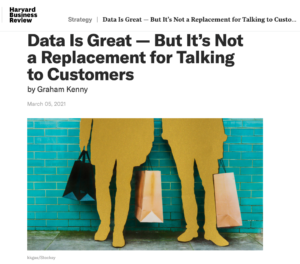
    Data Is Great — But It’s Not a Replacement for Talking to Customers

    By: Graham Kenny, CEO of Strategic Factors, is a recognized expert in strategy and performance

    Summary: Many companies rely too much on big data and analytics in their hunt for strategic insights.  They’d do better if they actually went out and talked to their customers instead, as Toyota and Adobe do, because data is too rooted in what managers already think their customers are interested in.

    Real insights come from seeing the world through someone else’s eyes. You will only ever get that by truly engaging with customers and listening to their stories.” ~ Graham Kenny


    Airbnb Resource Center 3/5/2020

    Lessons from interviewing 300 Airbnb hosts

    An author shares how any business can learn from Airbnb’s key principles.

    In his book “The Airbnb Way,” author Joseph Michelli interviewed hundreds of hosts and guests in 11 countries.

    • As a result, he believes any business can learn from five key principles.
    • These principles include belonging, trust, hospitality, empowerment, and community.

    By diving deeply into the life of our customers, we can follow their journey with our products and services. This process will uncover opportunities to better serve them and set a clear pathway for the future” ~ Lori Hamilton

    Inc 5/3/2013

    Airbnb Founder: Best Way to Get Inside Your Customers’ Heads

    Airbnb co-founder and CPO Joe Gebbia says his company uses one tactic to really understand the customer experience.

    He continued:

    So how do we bridge from our script to these real world experiences? We storyboard. And we storyboard like crazy. Last year we embarked on an ambitious project to map the entire guest and host terrain of Airbnb and we did it through illustration. We looked at key emotional moments of the journey and we drew them. We visualized them. And what it’s done for us, it’s allowed our entire company to achieve a whole new level of empathy with our customers.”

    Entrepreneur 2014

    Know Your Customers by Living a Day in Their Lives by Steve Blank

    One of the most powerful ways to understand your customers, whether they’re consumers or business customers, is to discover how they “work” and write it down, delineating a day in their life.


    Inc 5/3/2019

    Use Big Data–and Small Data–to Understand Your Customers

    Know the difference between big and small data? Using each could transform your business.


    Journal of Business Strategy

    Daily life, not markets: customer-centered design.

    See: https://www.id.iit.edu/wp-content/uploads/2015/03/Daily-life-not-markets_JBS_071.pdf


    Harvard Busines Report Jan/Feb 1994

    Spend a Day in the Life of Your Customers.


    Thanks for reading!


    If you would like to read back The Art of Business Transformation pieces, please visit here.  

  • July Reading and Watching

    July Reading and Watching

    Reading…

    As I’m thinking about kindness in the workplace, I went back to these three books that combine hard research with gentle persuasive techniques on how to be a better manager, how to make the workplace, and the world a better place.

    • Good to Great: Why Some Companies Make the Leap and Others Don’t – This book shows the clear correlation between management style and financial performance. The key finding is that leaders who focus on their teams, making others successful, are far better at managing their organizations to financial excellence. While leaders who focus on themselves, do much more poorly. Bottom line: listen first, take responsibility for yourself when things go wrong, and share the credit with others when things go right.
    • First, Break All the Rules: What the World’s Greatest Managers Do Differently – This book is a classic, required reading for my students at Columbia, NYU, and Pace University. It’s a global quantitative study on what makes a great workplace, and the impact when those factors are present. Surprisingly, what makes a great workplace are the same 10 things around the world – understanding the higher purpose of your work, having a clear direction, and the tools/resources you need to do that work, feeling that someone at work cares about you as a person. Give it read to up your game as a team leader and manager.
    • Dream Teams – This book explores what makes some teams work and some not. I have personally experienced this when I worked on a bank merger between Wachovia and First Atlanta Bank. In Wachovia’s culture, you write everything down because it shows transparency, integrity, and attention to detail; in First Atlanta’s culture, you only write down every detail if you’re getting ready to get someone else in trouble. Guess what happened when the two cultures merged? Dream Teams shows that the key to team success, particularly integrated teams (which is every team right now) is intellectual humility. Being willing to assume that you don’t know and can learn from others. That is the key to listening, collaborating, and seeing and evoking the best in others.

    Watching…

    One of my favorite ways to lift my spirits is to be inspired by the work of others. I hope you’ll find these ideas inspiring for you as well!

    • American Masters: Toni Morrison – Before winning the Nobel Prize in Literature, Tony Morrison was a single mom, a top editor for Random House, and an author. In the ’60s, as a black woman in New York. When she wrote The Bluest Eye, she asked the question “why do we assume the reader is white?” She also noted that the insidious nature of bias – any kind of bias – is not just what it does to society or to the people directly receiving that bias, the poison gets worse when we assume that it’s true ourselves. The Bluest Eye was inspired by a memory Toni had as a child of a 9-year old friend who said she didn’t believe in God anymore because he wouldn’t give her blue eyes. What had to happen to that little girl at age 9 to believe that she was not lovable, not OK, not acceptable because of the color of her eyes?
    • American Masters: Miles Davis – Did you know that Miles Davis attended The Juilliard School by day as he was inventing Cool Jazz at night in clubs on 52nd Street with Charlie Parker, John Coltrane, and Dizzy Gillespie? Me neither. Imagine being that talented, from a small town, and taking the musical world by storm. It wasn’t until he went to Paris that he experienced racial equality. Still, at the height of his success, he was arrested while standing under a marquee with his name on it. His alleged crime? Smoking a cigarette on the sidewalk in New York City. If you ever feel that life’s obstacles are too much, and you can’t continue being creative, look no further than the life of Miles Davis who stayed hopeful, productive, and generous to young people all his life.
    • Hamilton on Disney Plus  – I know everyone’s watching Hamilton these days. Here’s what I love about it.
      • First, Lin-Manuel Miranda writes in the spirit of Shakespeare – pop culture references galore. “Here comes the general!” is from a General Auto Insurance commercial.  “Immigrants, we get the job done” is from an old Marine’s ad. And “you’ve got to be carefully taught” is from a song about racism from the musical, South Pacific.
      • If you don’t know rap well, it may take you 20 minutes or so to get used to the language. Stick with it. It’s worth it. Even if you can’t understand the words, note the rhythms. Like Shakespeare, each character has his or her own rhythm. Many of them inspired by rap stars – Hercules Mulligan is modeled after Busta Rhymes.
      • And Miranda uses internal rhyming and alliteration to create patterns that show each character’s nature. Lafayette uses mottled rap because he’s not a native speaker of English. Jefferson’s rap seems behind the times because he’s been out of the country.
      • Another reason to be impressed by Hamilton is, it’s better than the piece itself. Lin-Manuel Miranda did something that no other Broadway producer I know has done. He shared the profits with the original team – cast, director, musical arranger. Usually, those folks get paid a salary for their time but don’t reap the rewards of a show’s success.
      • In addition, Miranda received a MacArthur grant that allowed him to provide 50,000 New York City students the chance to see the show on Broadway for free. It also set the stage for classrooms to use the curriculum to teach the show and help kids create their own versions of the songs.
      • Finally, Miranda has been a tireless worker and advocate for charity – from worker relief during COVID to Hurricane Maria in Puerto Rico, even purchasing a bookstore that was once a haven for theater writers and setting the stage of the next generation.
  • How to Brainstorm Remotely

    How to Brainstorm Remotely

    As many of you know, I’ve been facilitating creative sessions for quite a while. For those that don’t know, I have over 20 years of experience across many industries working with companies such as Google, Samsung, ConAgra, MetLife, Chase Manhattan, TIAA, The Home Depot, and many more. Our work has helped generate over $3 billion in incremental business.

    Here are some steps on how to brainstorm remotely:

    STEP ONE

    Start the meeting with a group review of whatever topic you are going to brainstorm on. It’s important for everyone to have a common understanding of the lay of the land – the product, the audience, the problem you are solving, whatever it may be.

    STEP TWO

    Create a series of questions to be answered in smaller groups. The most efficient size group for creating ideas is 1-3 people. I recommend creating separate zoom “rooms” for everyone to break out together.

    Each group should have a specific focus. Maybe it’s the audience, maybe it’s the problem you’re solving or the product area you want to explore. Come up with 3-4 ideas. That way you can have 3-4 small groups, more if you like. You can always have more than one group focus on the focus area.

    STEP THREE

    Reward each group with the NUMBER of ideas they come up with and time the results (1-3 minutes). Encourage everyone to say “yes and” to ideas. You never know which supposedly “bad idea” will lead to a good one. NO evaluating of ideas while you generate them. Give prizes (I’m serious – candy, toys, something fun and send it to the team members after the meeting. Make sure everyone gets something – even a wind-up toy. It will bring a smile to their face AND it will remind them of the meeting!)

    Examples of questions for ideation. After each breakout group, have the small groups share some of their ideas and have one person capture them all to send to the team later in the meeting.

    • Best and worst
      • What are the BEST ideas off the top of your head now?
      • What are the WORST ideas to totally RUIN your effort now?
      • Now, what are the opposite of the worst ideas?
    • Day in the life
      • What’s a day in the life of your audience?  What’s a good day? A bad day?
      • How could your product or service make a good day better?
      • How could your product or service make the bad day worse?
    • Projection ideas
      • If your product or service were a superhero, what would his/her name be? What would their superpower be?
      • Imagine you are in Mrs. Johnson’s 4th-grade class. You go visit your company, product, or service on a field trip. How do you make fun of the company n the bus ride home? Now, what ideas would your 4th’ grade self have for your product or service?
      • Think of an innovator (musician, technology, writer, artist, any kind of inventor).  If that innovator were your chief marketing officer, what would THAT person do for your product or service?
      • After these ideas, ask “what part of these ideas could you actually use?”

    STEP FOUR

    Get consensus. Once you’ve got all the ideas done, email everyone in the group the list of ideas. You might also do this on a quick online survey. People will pick their top 3-5 ideas. Guess what? INSTANT consensus!

    STEP FIVE

    Next steps: if you have time, brainstorm on the ultimate outcome, the ideal future, Then talk about how that could fail, What are the obstacles? How can we overcome these obstacles? What are the first, easiest steps to take toward success?

    Good luck!

    Lori Hamilton, Founder

    Prosperity Productions, Inc.